Westward Women: A Book Review

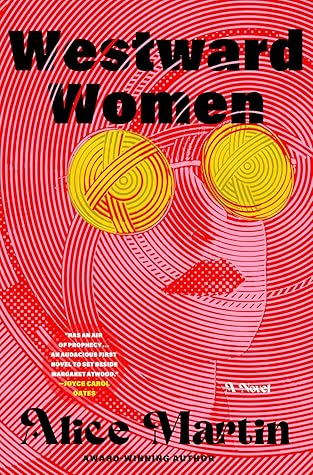
Westward Women: Alice Martin

Westward Women by Alice Martin

My rating: 4 of 5 stars


Many thanks to Netgalley for the opportunity to read this ARC in exchange for my honest review.

As a lover of dystopian fiction I got really excited about this book! And also, as a current North Carolinian, also excited to read something from one of our own. From the description this seemed right up my alley, especially as someone who once – and perhaps still – suffers from this westward disease, the inexplicable pull toward the what we settler colonialists have always liked to think of as an unexplored “frontier…” (full disclosure: American history is my academic focus, and I’m obsessed with “westward expansion,” which we’ve always romanticized – and which I can assure you is much, much more violent than that).

Well, I’ll tell y’all, I spent the majority of this book waiting for something to happen – it’s a slow burn, but stick with it. The author is talented. I’m pretty sure that this sleepy pace is intentional.

What held me most was the characters themselves, and perhaps that was intentional. The author is fantastic at building out a character and you spend the entire time living in their heads or observing them, trying to figure out whether this westward direction is literal or figurative or both. I am still undecided what to make of it, to be honest. That’s what pushed this from a 3.5 to a 4 for me – I’m still thinking about it.


View all my reviews

A weird book you should read.

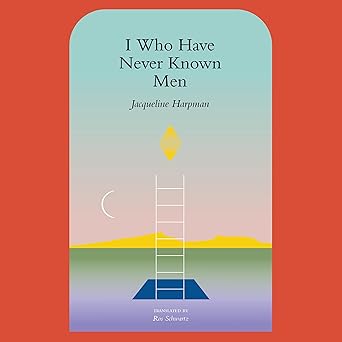
I Who Have Never Known Men cover

I Who Have Never Known Men by Jacqueline Harpman

My rating: 5 of 5 stars


I am grateful to Echo Books for putting this audiobook out in 2024, as this book was originally published in 1995 and didn’t get nearly the awareness it deserved back then. And I am grateful to the Greensboro Public Library for once again doing the subversive thing and adding it to their most recent audiobook acquisitions.

Given the suburban sprawl of this city, I’m in my car a lot. I need engaging audiobooks to stay sane. The story needs to be good and the narrator does, too – it’s important that the narrator ACT the characters, not just read them, or one can easily get lost in the effort required to differentiate between characters. The story and the narrator are good here.

This book is short. As an audiobook, it’s only six hours in its entirety, but it’s six hours of brilliance. I feel honored to have finally joined the small legion of people who are now aware of the genius of this author (and also the translator, who has maintained the integrity of the original French work – it can be extremely challenging to do this when the nuances of a different language can easily be lost in translation).

I’ll read this again at some point, probably in book form, to see what I missed in a listen. Without giving away too much, let’s just say that the manner in which this book is constructed means that the narrator’s experiences are also ours in a way. The hope, the desolation and loneliness, the curiosity, and the desire to know where she is, why she’s there, and whether she’ll ever encounter anyone else alive is something we also hope to discover, and which create an agonizing ache that keep us attached to the story until the very end as we experience a similar anguish as the narrator herself.

I realize that’s not the greatest description of this when this could be applicable to any good story – but I’m trying not to leave spoilers here. If you read this, you’ll understand what I mean. This takes place on a much more “meta” level than the typical desire to know the conclusion of a tale. I’m sure there’s probably a named literary device for this that I don’t know.

I’m still on the lookout for a good speculative fiction book club. If I ever find one, I’ll recommend this one in a heartbeat. It’s incredibly discussion-worthy. Again, I’m glad that someone at Echo Books had the foresight to retrieve this book from relative anonymity and bring it back out into the light for a new generation of readers and listeners.


View all my reviews

On letting go of extraordinary ambition

The feeling of it is indescribable.

In a place like the one where I am now, it’s very easy to get caught up in the dreams of others, tossed into a pot of brilliance as we all are.

I remembered though, recently, that my walk is my own; I don’t have an entire life ahead of me anymore, just half of one, probably. My life already reads as a list of grand adventures and minor accomplishments, and I have little desire to let go of some of the things I had before immersing myself in academia: a garden, a wildness, time to create and enough of an income to provide for my daughter and pay for a pleasurable life lived within our means.

I’d felt isolated, but now I know why. The separation was only painful because I was unwilling to accept the truth: I am different, I am in a different place in my life, I believe that knowledge is power, I’m already good at what I do and being able to study and network with top-notch professionals is an icing on the cake. And I know exactly where the few people I can count on here are. This is literally all that matters right now.

I came here with much more noble ideas. I am finishing my stay with the realization that I am at a zenith. It’s time to reflect.

It’s a story that was told to me many years ago, but I only chose to remember half of it. I would eventually come to this place. I would eventually have things to accept. I would have to come to terms with what I’ve always known: regardless of how loudly I shout, I’m more effective when people don’t know who it is that’s yelling.

I will relax into doing something for sheer joy, with the knowledge that my choice to do so is a radical act in and of itself. It doesn’t require age to earn the privilege of pleasure or creative expression. Anyone who’s been doing the hard work of trying to make the world a better place deserves to settle into the goodness of a present, and we deserve to have the time to create that space if it’s not already there.

I don’t need to be a hero, I just need to live, to show my daughter how it’s done, to make sure she and others have the space they need to be joy.

These eyes.

A riot of color welcomed me, and a quiet cacophony of hummingbirds and bees, butterflies, other little things come to get drunk on flower sperm and help keep the vibe alive. I was there to see it for her, to relieve some of the pressure of maintaining a garden, of dealing with glaucoma, of not being able to see the finer details anymore. 

She was something of a hedge witch though. She knew where she’d planted things, could still see when the deer had helped themselves to the boneset, knew when it was time to prune so plants had more energy to regenerate. She had me wage war on the anemones, the beautiful white flowers that built networks just under the surface of the soil and spread like a California wildfire. This war, this endless war, had me returning each week to listen to the sounds of the wind in the poplars, to uncover beetle nests with delight, to run to her like a child because I’d found the first monarch caterpillar of the season and it was eating something other than milkweed.

What was this plant, I wondered? She held it close and then far, then sniffed at it, closing the worse of her two eyes in hopes of catching a clearer glimpse.

“I don’t know. I don’t know.” 

I was on the clock, so sharing wonder was as far as I could digress. I’d left my phone in the car, the one with the plant ID app. She would have been a bit disgusted, I think, had I consulted it first, a bit angry with everything, the kids these days, kids being relative since there I stood at nearly fifty, wide-eyed with wonder at a caterpillar, holding it out to my 74-year-old friend.

I was still young, to her. Though mine, too, were beginning their decline, I could still be her eyes, so I needed to be good at it. I pinched a sprig and put it between the pages of a book, the book I’m reading, the book I can read. I would look it up later, come up with a way to tell her how I found my way to its name. 

She was already losing so much magick, so much magick. I hoped that after I left, she sat and looked at the shapes I’d created as I cleaned up the beds and gave the plants room to breathe. I hoped that she sat there and listened to the music—the wind in the poplars, all the sweet pollinators who’d come to her oasis, the offering her garden gave her in exchange for the love she gave it, for the love that I, through proxy, now continued.

Star Land

STARLAND by Robert S. Ball | sanguine meander

As part of an online class discussion, I had to stop by Project Gutenberg and look around.

Simultaneously I got pinged with a couple of YouTube videos to check out.

The end result of this combination was that I was listening to Tiny Desk while looking at old books online. I am drawn to books published during La Belle Epoque and Art Deco periods. Perhaps that taste is simple, but I don’t care. It warms me in a weird way.

I’ve seen this art before. My grandmother used to buy old hardcover books at the Value Village when I was growing up. She’d read from day to night sometimes, during those periods I can now identify clearly but back then were simply days I’d have to go buy her cigarettes for her with a note and some extra change for a candy bar. My grandmother had her up moments, her very up moments, and then she had her down ones, her very very down ones. She cycled pretty rapidly.

During the reading times she sat by her bedroom window, bottles of nitroglycerin scattered around on her bedside table. She’d look out the window to the street, chainsmoke her Carlton 120 menthols and read these books. Periodically she would demand something of me and eventually I would remove a stack of books from her bedroom and stack them somewhere else, usually on the stairs going down to the basement. When the stairs got dangerous, the books would move to the basement itself, where I would put them on a huge floor-to-ceiling bookshelf that took up one wall. When that was full, I began stacking them on the floor. My family’s baggage was written on pages.

When she died, my mother had to go several states back home and clean out the house. It is good I did not go. In her old-fashioned penmanship (who has that, anymore?) she’d written a book review in all of them. It is good I did not go. I would live among stacks of musty old books and I would have tried to carry them with me.

My mother remembers more about them than I do. She saw them last. What I  remember is the feel of those books, their burlappy covers and ridged fore edges that looked like my grandmother’s nails, but soft.

I couldn’t talk about the walls those books built until I moved to Star Land.


Here are some of the ones I enjoyed thanks to Project Gutenberg. Content must be considered within the context of the time during which it was published, you’ve been warned:

Star-Land – 1889

Tillicums of the Trail – 1922

Die Hexe von Norderoog – 1908

The Bear Family at Home, and How the Circus Came to Visit Them – 1908, 1923

And here are the Tiny Desk concerts that accompanied this:

Lizzo

Gallant

Masego

Tash Sultana